Obstetrics and Gynecology
04 Oct 2026
Endometriosis Symptoms, Diagnosis & Treatment | University Hospital Sharjah
Reviewed by

Dr. Fayez Abokharoub
HOD ,Consultant Obstetrician & Gynecologist
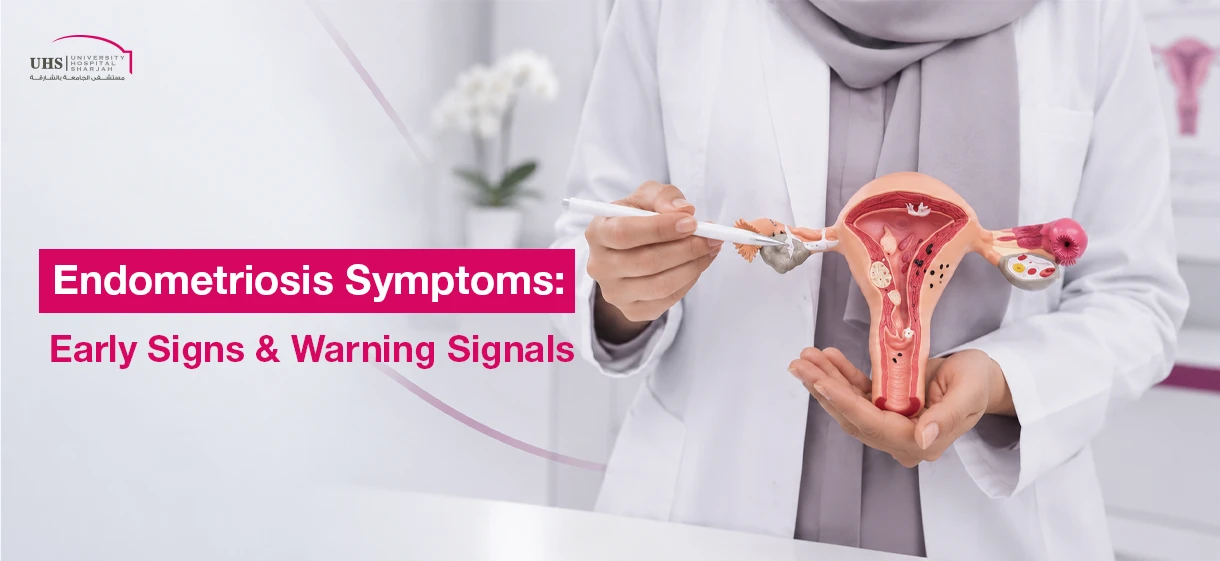
Endometriosis is a chronic gynecological condition that can cause persistent pelvic pain, painful periods, discomfort during intercourse, digestive symptoms, and difficulty conceiving. However, Endometriosis Symptoms vary considerably from one woman to another. Some women experience severe pain that disrupts daily life, while others have only mild symptoms or discover the condition during fertility investigations.
Recognizing the signs of endometriosis early can help women seek appropriate gynecological assessment and avoid prolonged delays in diagnosis. Severe menstrual pain should not automatically be considered normal, particularly when it interferes with work, sleep, exercise, or everyday activities.
At University Hospital Sharjah, the Obstetrics & Gynecology team provides specialist evaluation for women with chronic pelvic pain, menstrual concerns, and fertility difficulties, supported by diagnostic imaging and minimally invasive gynecological care when clinically appropriate.
What Is Endometriosis?
Endometriosis is a chronic inflammatory condition in which tissue similar to the lining of the uterus develops outside the uterine cavity. These lesions may occur on the ovaries, fallopian tubes, pelvic lining, and other nearby structures.
The tissue responds to hormonal changes during the menstrual cycle and can contribute to inflammation, irritation, scar tissue, and adhesions. These changes may lead to pelvic pain, painful periods, fertility difficulties, or symptoms involving the bowel or bladder.
Some women with endometriosis have significant symptoms, while others may have little or no pain. The severity of symptoms does not always reflect how extensive the disease is.
What Causes Endometriosis?
The exact cause of endometriosis is not fully understood. Research suggests that several biological, hormonal, genetic, immune, and anatomical factors may contribute to its development.
Hormonal Factors
Endometriosis is influenced by reproductive hormones, particularly estrogen. Endometriosis lesions can respond to hormonal changes during the menstrual cycle, contributing to inflammation, pain, and progression of symptoms in some women.
This hormonal sensitivity is also why many non-surgical treatment for endometriosis options focus on suppressing ovulation or modifying hormonal stimulation.
Family History
Genetic susceptibility appears to play a role in endometriosis. Women with a close family member who has the condition may have a higher likelihood of developing it themselves.
A family history does not mean that endometriosis will definitely occur, but it can be an important part of the medical assessment when symptoms such as severe period pain or infertility are present.
Menstrual Cycle Irregularities
Certain menstrual patterns may be associated with a higher likelihood of endometriosis, although irregular periods themselves are not considered a direct cause.
Factors such as shorter menstrual cycles, heavier menstrual flow, or longer periods may be relevant when the gynecologist evaluates symptoms and overall risk.
Because several mechanisms may contribute to the condition, no single cause explains every case.
Common Symptoms of Endometriosis
Endometriosis Symptoms can range from mild to severe and may appear gradually.
Common symptoms include:
Severe menstrual cramps.
Chronic pelvic pain.
Pain during or after sexual intercourse.
Heavy menstrual bleeding.
Painful bowel movements or urination during menstruation.
Bloating and digestive discomfort.
Difficulty conceiving.
Some women with endometriosis may have no obvious symptoms at all and are diagnosed during fertility evaluation or surgery for another condition.
Severe Pelvic Pain and Intense Menstrual Cramps
Pelvic pain is one of the most recognized Endometriosis pain symptoms.
Women may experience:
Severe cramping before or during menstruation.
Lower abdominal or pelvic pain.
Pain that radiates to the lower back.
Pain that worsens over time.
Chronic pelvic discomfort between periods.
Painful periods are common, but pain that significantly disrupts daily activities or does not improve with usual measures deserves medical evaluation. Endometriosis is an important medical cause of secondary menstrual pain.
Pain During or After Sexual Intercourse
Pain during or after intercourse can occur when endometriosis affects structures deeper in the pelvis.
The discomfort may be felt as:
Deep pelvic pain.
Pressure.
Sharp pain.
Persistent aching after intercourse.
Because painful intercourse can also result from other gynecological, pelvic floor, or urinary conditions, a specialist evaluation is important when the symptom persists.
Heavy Menstrual Bleeding or Bleeding Between Periods
Some women with endometriosis experience heavier-than-usual menstrual bleeding or bleeding between periods.
Heavy bleeding can also occur with conditions such as fibroids, adenomyosis, hormonal disorders, or other gynecological problems, so it should not be assumed to be caused by endometriosis without proper assessment.
Persistent heavy bleeding may also contribute to iron deficiency and anemia.
Pain During Urination or Bowel Movements During Your Period
Endometriosis involving areas near the bladder or bowel can cause pain that becomes particularly noticeable during menstruation.
Symptoms may include:
Pain during bowel movements.
Rectal pressure.
Painful urination.
Pelvic pain associated with bladder filling.
Symptoms that consistently worsen around the menstrual period.
ACOG recognizes pain during bowel movements and urination as possible manifestations when endometriosis affects the bowel or bladder.
Digestive Problems and Persistent Bloating
Some women experience digestive complaints such as:
Persistent or cyclical bloating.
Constipation.
Diarrhea.
Abdominal discomfort.
Nausea.
Changes in bowel habits around menstruation.
These symptoms are not specific to endometriosis and can overlap with gastrointestinal conditions such as irritable bowel syndrome.
A pattern in which digestive symptoms repeatedly worsen around menstruation can be useful information during gynecological evaluation.
The Relationship Between Endometriosis and Difficulty Conceiving
Endometriosis and fertility are closely connected because the condition can affect several parts of the reproductive system.
Inflammation, adhesions, ovarian involvement, and changes around the fallopian tubes may interfere with the normal interaction between the egg and sperm or with transport through the reproductive tract.
ACOG notes that endometriosis is found in a substantial proportion of women being evaluated for infertility.
However, having endometriosis does not mean pregnancy is impossible.
Some women conceive naturally, while others may benefit from fertility treatment depending on:
Age.
Ovarian reserve.
Severity and location of endometriosis.
Fallopian tube function.
Partner fertility factors.
Duration of infertility.
Previous treatment.
Treatment planning should therefore balance pain control, disease management, and future pregnancy goals.
Stages and Severity of Endometriosis
Endometriosis stages are commonly classified according to the location, extent, and depth of lesions, the presence of adhesions, and ovarian involvement.
The traditional staging system ranges from:
Stage I – Minimal
Stage II – Mild
Stage III – Moderate
Stage IV – Severe
A higher stage generally indicates more extensive anatomical disease.
However, the stage does not always correspond directly with pain severity. A woman with relatively limited disease may experience severe pain, while another woman with more extensive endometriosis may have fewer symptoms.
For this reason, treatment decisions are based not only on stage but also on symptoms, fertility goals, imaging findings, age, and individual health considerations.
How Is Endometriosis Diagnosed?
Diagnosis usually begins with a detailed history and clinical assessment.
Current guidance increasingly supports a clinical and imaging-based approach before surgery. Ultrasound and MRI can identify ovarian endometriomas and many forms of deep endometriosis, although a normal scan does not exclude superficial disease. Laparoscopy may still be considered when imaging is negative but symptoms remain strongly suggestive, or when treatment has not been effective or is inappropriate.
Medical Examination and Medical History
The gynecologist may ask about:
Severity and timing of pelvic pain.
Menstrual cycle pattern.
Pain during intercourse.
Bowel or bladder symptoms.
Fertility history.
Previous pregnancies.
Family history of endometriosis.
Previous pelvic surgery.
Medications and hormonal treatment.
A pelvic examination may help identify areas of tenderness, masses, or reduced mobility of pelvic structures, although a normal examination does not rule out endometriosis.
Specialized Ultrasound and Magnetic Resonance Imaging (MRI)
Specialized pelvic ultrasound is often an important part of the evaluation.
It may help identify:
Ovarian endometriomas.
Deep endometriosis.
Adhesions or altered pelvic anatomy in selected cases.
Other gynecological conditions that may explain symptoms.
MRI can provide additional anatomical detail, particularly when deep disease is suspected or when surgical planning requires more precise mapping.
Imaging is recommended in the diagnostic work-up, but negative ultrasound or MRI findings do not completely exclude endometriosis, especially superficial peritoneal disease.
Diagnostic Laparoscopy
Laparoscopy is a minimally invasive surgical procedure in which a thin camera is inserted through small abdominal incisions to examine the pelvis directly.
It can allow the surgeon to identify endometriosis lesions and, in appropriate cases, remove or treat them during the same procedure. Tissue may also be sent for histological examination.
Modern guidance no longer considers diagnostic laparoscopy necessary as the first step for every patient. It may be particularly useful when:
Imaging is inconclusive.
Symptoms remain significant despite treatment.
Surgery is already being considered.
Fertility-related anatomy requires assessment.
Deep or complex disease is suspected.
This more individualized approach is central to contemporary Endometriosis diagnosis MRI and laparoscopy pathways.
How Can Endometriosis Symptoms Be Managed?
Treatment depends on the patient's symptoms, age, disease location, fertility plans, previous treatment, and overall health.
There is no single treatment suitable for every woman.
Hormonal Treatments and Pain Relievers
For many women whose main concern is pain, medical treatment may be considered before surgery.
Options can include:
Nonsteroidal anti-inflammatory drugs for pain relief.
Combined hormonal contraceptives.
Progestin-based therapy.
Hormonal intrauterine systems in selected patients.
Gonadotropin-releasing hormone therapies in appropriate cases.
Hormonal treatment aims to reduce stimulation of endometriosis lesions and improve pain, but it does not permanently eliminate all existing disease.
The choice of therapy depends partly on whether pregnancy is currently desired, as many hormonal treatments suppress ovulation while being used.
Laparoscopic Surgery to Remove Endometriosis Tissue
Surgery may be considered when:
Pain remains severe despite appropriate medical treatment.
Endometriosis significantly affects pelvic organs.
An ovarian endometrioma requires treatment.
Deep endometriosis is suspected.
Fertility-related anatomical problems need treatment.
Imaging demonstrates disease that is appropriate for surgical management.
Laparoscopic surgery can be used to remove or destroy endometriosis lesions and release adhesions while minimizing abdominal incisions. Surgery may improve pain and, in selected patients, fertility outcomes.
However, surgery does not guarantee permanent cure, and symptoms can recur. Long-term follow-up and postoperative hormonal treatment may be considered depending on the patient's pregnancy plans and clinical situation.
Is Severe Period Pain Normal or Could It Be a Sign of Endometriosis?
Some menstrual cramping is common, particularly during the first days of a period.
However, severe pain should not automatically be dismissed as normal.
Medical evaluation is advisable when period pain:
Prevents you from going to work or school.
Regularly interrupts sleep.
Requires increasingly strong pain medication.
Causes vomiting or faintness.
Is becoming progressively worse.
Occurs alongside painful intercourse.
Is associated with painful bowel movements or urination.
Continues outside the menstrual period.
Is accompanied by difficulty becoming pregnant.
Endometriosis is one possible cause, but other conditions such as adenomyosis, fibroids, pelvic inflammatory disease, ovarian cysts, or pelvic floor disorders may cause similar symptoms.
A gynecological evaluation can help determine the underlying cause rather than simply treating repeated pain episodes.
When Should You Seek Immediate Medical Consultation?
Most endometriosis symptoms require planned specialist evaluation rather than emergency treatment. However, urgent medical assessment is appropriate if you develop:
Sudden, severe, or rapidly worsening pelvic or abdominal pain.
Heavy vaginal bleeding with dizziness, weakness, or fainting.
Severe pain accompanied by persistent vomiting.
Fever with significant pelvic pain.
Loss of consciousness.
Severe abdominal swelling or inability to pass urine or stool.
Pelvic pain with a possible or confirmed pregnancy.
These symptoms may indicate complications or another acute condition requiring prompt evaluation.
Endometriosis Care at University Hospital Sharjah
Persistent pelvic pain, severe menstrual symptoms, or difficulty conceiving should not be ignored. A detailed gynecological assessment can help identify whether endometriosis or another condition is responsible and guide an individualized management plan.
Chronic pelvic pain shouldn't hold you back. Book your consultation at University Hospital Sharjah today to receive accurate diagnostic evaluation and advanced care from our leading OB-GYN specialists.
Frequently Asked Questions
Can an ultrasound detect endometriosis?
Yes, ultrasound can identify some forms of endometriosis, particularly ovarian endometriomas and many cases of deep pelvic endometriosis when performed by appropriately trained clinicians.
However, a normal ultrasound does not completely rule out endometriosis, especially superficial disease. MRI or further evaluation may be recommended depending on symptoms and clinical findings.
Is endometriosis curable?
Endometriosis is generally considered a chronic condition rather than one that can always be permanently cured.
Hormonal treatment and surgery can significantly reduce symptoms and control the condition, but lesions or pain may recur after treatment. Management therefore focuses on long-term symptom control, fertility goals, and quality of life.
Does endometriosis mean you cannot get pregnant?
No. Endometriosis does not mean pregnancy is impossible.
Many women with the condition conceive naturally. Others may need fertility treatment depending on disease severity, ovarian reserve, tubal function, age, and other fertility factors.
An individualized assessment can help determine whether expectant management, surgery, ovulation-related treatment, intrauterine insemination, or IVF may be appropriate.
What is an endometrioma (chocolate cyst)?
A chocolate cyst of ovary, medically known as an ovarian endometrioma, is a cyst that develops when endometriosis affects an ovary.
It contains old blood products that can give the cyst a dark brown appearance, which is why it is commonly called a “chocolate cyst.”
Endometriomas may cause pelvic pain, may be associated with fertility concerns, or may sometimes be found incidentally during ultrasound. Treatment depends on the cyst's size, symptoms, appearance, fertility goals, ovarian reserve, and other clinical factors.